

The escalation around Iran is now directly impacting global logistics.
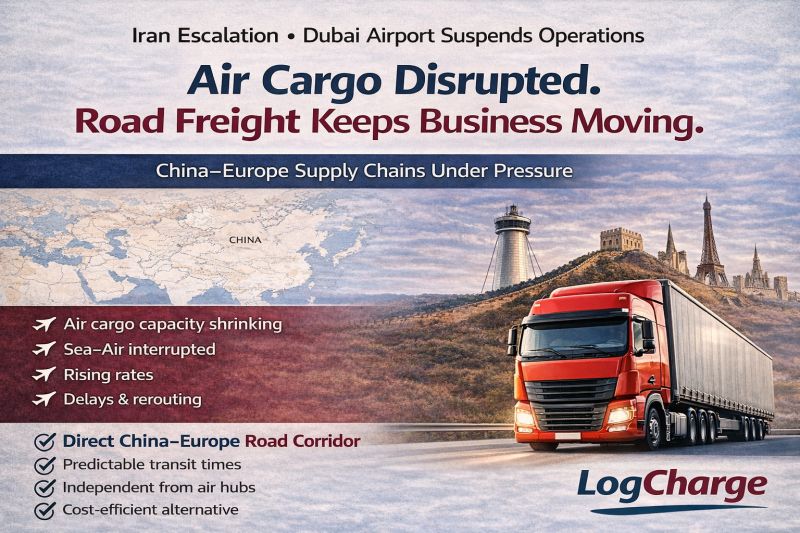
With Dubai Airport suspending operations, one of the most important air cargo hubs between Asia and Europe is out of operation.
What this means for China–Europe transport:
✈️ Immediate air cargo shortages
✈️ Sea–Air solutions interrupted
✈️ Rerouting chaos
✈️ Rising air freight rates
✈️ Delays for time-critical shipments
For many companies, their fastest logistics option just disappeared.
🚛 Road Freight Keeps Business Moving.
While air freight tightens, the direct China–Europe road corridor remains fully operational.
✔️ No dependency on Middle East air hubs
✔️ No Sea–Air exposure
✔️ Predictable door-to-door transit times
✔️ Significantly more cost-efficient than air freight
✔️ Built for resilient supply chains
But more importantly:
Road freight is no longer just a backup option.
It has become a strategic layer in supply chain design.
Companies that rely on a single mode of transport are the most exposed when disruptions hit.
Those with diversified routing options can react faster, maintain delivery commitments, and protect their operations.
The China–Europe road corridor offers exactly that:
control, flexibility, and independence from volatile air and sea bottlenecks.
It’s not about replacing air freight entirely —
it’s about having a reliable alternative when speed, predictability, and continuity matter most.
Disruptions are becoming the norm.
The only real question is:
How exposed is your China–Europe setup right now?
📩 If you need a reliable alternative to air freight — let’s talk.